Showing posts with label GST consulting services. Show all posts

Wednesday, 30 July 2025

Why Accurate GSTR 9 Filing Matters for Dwarka-Based Businesses


Filing GSTR 9, the annual GST return, is a mandatory compliance step for most regular taxpayers. But for many businesses in Dwarka, Delhi, GSTR 9 is often seen as a formality—until an error leads to penalties, mismatches, or GST scrutiny.

This blog explains why accuracy in GSTR 9 annual return filing in Dwarka is critical, and how you can avoid common mistakes with professional guidance.

GSTR 9: More Than Just a Summary

Unlike monthly or quarterly returns like GSTR-1 and GSTR-3B, GSTR 9 is a consolidated return that includes:

  • Total outward and inward supplies

  • Amendments, credit notes, and debit notes

  • Input Tax Credit (ITC) claimed and reversed

  • Late fees, interest, and tax payable or paid

  • HSN-wise summary of goods and services

Filing this incorrectly can create inconsistencies across your GST records and raise red flags for audits.

The Real Cost of Inaccurate GSTR 9 Filing

1. Triggering GST Notices

Mismatch in turnover, tax paid, or ITC claimed could prompt the GST department to issue a notice or scrutiny order.

2. Loss of Eligible ITC

Failure to reconcile ITC accurately can lead to loss of input credit that could otherwise reduce your tax burden.

3. Financial Penalties

Incorrect declarations or non-disclosure of liabilities may result in penalties under Sections 122 and 125 of the CGST Act.

4. Hindrance in Refund Claims

An erroneous GSTR 9 can delay or disqualify you from GST refunds for exports or inverted duty structures.

Why Dwarka-Based Businesses Need to Be Extra Cautious

Dwarka, being a thriving commercial and retail zone in Delhi, has businesses with:

  • High transaction volumes

  • Multi-state or e-commerce operations

  • Vendor invoices from various sectors

  • Seasonal and irregular supply flows

These businesses are more prone to input mismatch and reconciliation errors, making accurate GSTR 9 filing in Dwarka even more essential.

How Tax Consultants in Dwarka Can Help

1. Detailed Reconciliation

They match your books with GSTR-1, GSTR-3B, and GSTR-2B to ensure numbers align perfectly in the annual return.

2. ITC Verification

Consultants ensure your ITC claims are fully supported by invoices uploaded by vendors, minimizing rejections.

3. HSN Summary Accuracy

Many errors happen in the HSN code reporting. Local experts are familiar with industry norms and ensure correct entries.

4. Correct Reporting of Advances and Adjustments

A common area of error—consultants ensure you accurately report any advance payments or adjustments made during the year.

Common Mistakes Consultants Help You Avoid

  • Copy-pasting data from GSTR-3B without validation

  • Ignoring ITC reversals due to ineligible credits

  • Skipping reconciliation with actual turnover

  • Misreporting credit notes and debit notes

  • Leaving HSN summary fields incomplete

Frequently Asked Questions (FAQs)

1. Can I use my monthly GST data directly in GSTR 9?
Not always. It must be reconciled first, especially for turnover, ITC, and amendments.

2. Do I need to file GSTR 9 if my turnover is under ₹2 crore?
Filing GSTR 9 is optional below ₹2 crore, but recommended for good compliance history.

3. How do I know if I made a mistake in GSTR 9?
If post-filing reports don’t match with books or GSTR-3B, or you get a notice, it may indicate an error.

4. Can a local consultant help even if I’ve already filed GSTR 9?
Yes. They can review your filing and help with damage control or notice responses if needed.

5. What’s the deadline for GSTR 9 filing?
Usually December 31st following the end of the financial year, unless extended by CBIC.

Final Thoughts

Don’t let GSTR 9 become an afterthought. Inaccuracy in this single return can undo months of compliance efforts and expose your business to audits or penalties. If you're operating in Dwarka, partnering with a local GST consultant ensures you file correctly, completely, and confidently.

When in doubt, let a professional do the math—and the filing.

Wednesday, 23 July 2025

GST experts in India


Whether you're running a startup, SME, or a multinational, navigating India’s GST regime is a crucial part of doing business. The complexity of tax returns, frequent law changes, and risk of penalties make it nearly impossible to manage everything in-house. That’s why more and more businesses are turning to GST experts in India—professionals who bring clarity, accuracy, and peace of mind.

The Growing Complexity of GST Compliance

More Than Just Filing Returns

GST is not just a tax—it’s a multi-step process involving classification, invoicing, return filing, reconciliation, and compliance tracking. One small error can trigger notices or financial loss.

Businesses Face Increased Scrutiny

With real-time data sharing and automated GST audits, the government is closely watching inconsistencies. Businesses that aren’t compliant risk reputation damage and operational delays.

How GST Experts in India Help You Stay Ahead

GST Setup and Registration

Experts help ensure that your GST registration is filed correctly from day one—assigning the correct HSN codes, categories, and locations.

Monthly & Annual GST Returns

They handle regular filings like GSTR-1, GSTR-3B, GSTR-9, and help reconcile them with purchase and sales records to prevent mismatches.

Representation in Disputes

If your business receives a notice or is under audit, GST consultants defend you legally and prepare robust documentation.

Key Benefits of Partnering With GST Experts

  • Compliance Without Stress: Experts handle all deadlines and updates

  • Error Reduction: Avoid costly mistakes in returns, ITC claims, or vendor invoices

  • Business Insights: Get detailed reporting to better understand your tax position

  • Cost Savings: Maximize tax credits and reduce unnecessary tax outflows

Real Example: Manufacturing Business in Gujarat

A mid-sized manufacturer in Gujarat faced repeated issues with blocked ITC and vendor mismatches. With the help of a GST expert, they streamlined vendor selection, trained internal staff, and recovered input credits worth over ₹8 lakhs in six months.

What to Look for in a GST Expert

  • Experience with your industry vertical

  • Proficiency in GST software & automation tools

  • Ability to offer end-to-end compliance support

  • A proactive approach to tax strategy and risk reduction

FAQs

1. Do I need a GST expert even if I use accounting software?
Yes. Software can automate basics, but experts interpret laws and ensure full compliance.

2. Can experts handle multi-state GST filings?
Absolutely. Professionals help businesses with GST compliance across various states in India.

3. Is outsourcing GST services expensive?
Not at all. Most experts offer cost-effective plans based on your business size and needs.

4. What if my returns are delayed?
A GST expert helps manage backlogs and prevents penalties by catching up quickly.

5. Do they offer advice on GST refund eligibility?
Yes, from exporters to inverted tax structure claims, they assist in end-to-end refund processes.

Conclusion

Managing GST doesn’t have to be a source of stress. With the help of reliable GST experts in India, you gain efficiency, save money, and protect your business from costly non-compliance. From registration to audits—they help you build a stronger, more resilient tax structure.

Thursday, 6 June 2019

New Era of Accounting-Transition to Ind as


1. INTRODUCTION
The Indian Accounting Standards (IND AS) are Accounting Standards, harmonized with IFRS (International Financial Reporting Standards)/IAS (International Accounting Standards) to make Financials Accounts and Reports of Indian Companies internationally accessible, acceptable, transparent and comparable.
(ICAAP) (IFRS)
Indian Companies have a far more global access as compared to earlier days and also because of leveraged policies of Indian Government toward the flow of FDI, a need was felt to introduce globally accepted Accounting Standards (IFRS). Most of the Countries in the world follow or adopt IFRS/IAS issued by International Accounting Standard Board (IASB). In India the Government has decided to converge and not to adopt IFRS. So, the converged IFRS named as IND AS has been notified by Government to implement it in phased manner by Indian Companies.
In this article we shall discuss the implementation of IND AS and its transitional impact on Indian Companies.
2. APPLICATIONS
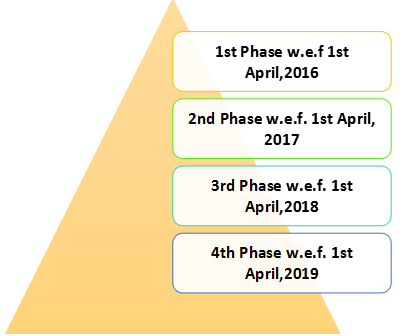
The Ministry of Corporate affairs (MCA) has notified the Companies (Indian Accounting Standards) Rules, 2015 for implementation of IND AS on Indian Companies in phased manner. Initially in 2015, the applicability of IND AS was on voluntary basis for the accounting period beginning on or after 1st April, 2015.
Voluntary Basis
Mandatory Application
The Government has notified the mandatory application and preparation of financial statements of certain class of Indian companies, other than Banking Companies, Insurance Companies and NBFC’s, in the phased manner;
Mandatory Application
Mandatory Application 1
Notes:
a. Companies listed on SMEs Exchange are not required to apply IND AS.
b. Once IND AS becomes applicable it becomes applicable in all the subsequent financial statements even though it has been voluntary applied.
c. Net worth shall be checked for past three financial Year and it shall be calculated on standalone accounts of the company.
d. Companies not covered by the above roadmap shall continue to apply Accounting Standards notified in Companies (Accounting Standards) Rules, 2006.
a. IND AS will be applicable for both the consolidated and Individual Financial statements.
b. NBFCs having net worth below Rs. 250 crores shall not apply Ind AS.
c. Adoption of Ind AS is allowed only when required as per the roadmap. Voluntary adoption of Ind AS is not allowed
Banking Companies and Insurance Companies
From the above, it seems that the Government of India is intentionally implementing IFRS converged Ind AS in the phased manner on Indian Corporates to bring the Financial Accounts and reports of the Indian corporates, its subsidiary, Associates and JV more transparent, comparable and globally acceptable. In so far as 39 Ind AS have been notified by the Ministry of Corporate Affairs in consultation with ICAI.
3. CHALLENGES AND OPPORTUNITY
There are a lot of challenges and opportunities in implementing Ind AS on Indian Corporates. There is a saying that “Challenges bring new opportunities” only the need is to understand the challenges and convert them into opportunities”.
The Challenges of implementing Ind AS before the Indian Corporates could be well understood and minimized by knowing the impact of implementing Ind AS.
CHALLENGES AND OPPORTUNITY

Challenges of Ind ASOpportunity in Ind AS
1.Shift from conventional cost method of Accounting to Fair Value Method of Accounting.Fair Value Method of Accounting brings the transparency and true and fair presentation of financial transactions.
2.Changes in the various laws like The Companies Act, SEBI Regulations, Taxation Laws Banking and Insurance Laws/ Regulations etc.Better Comparability and enhanced linkage to International trade and Business. It makes Cross Border acquisition and Joint Venture possible.
3.Lack of Expert and awareness about international practices.New opportunities for Professionals and Business at large.
4.Change of Management Reporting System and Internal Control.Reduction in reporting Cost, especially, in case of multinational companies.
5.Lack of awareness among users and stakeholders at Large.New opportunities in service sector and professionals.
4. IMPACT OF IMPLEMENTATION OF IND AS ON INDIAN COMPANIES:
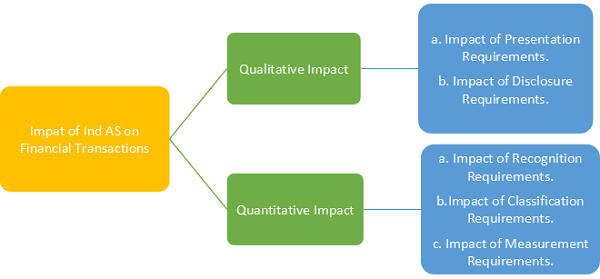
Implementation of Ind AS has changed the base and face of Financial Statements and Reports of Indian Corporates. It has changed not only the manner of presentation of Financials statements but also the principle of recognition and measurement of financial transactions and records. Therefore, we can say the conversion or transition to Ind AS is going to impact in both way qualitatively as well as quantitatively.
Qualitatively
In this section we will discuss the impact of Ind AS on Indian Companies and their effect in comparing Indian Accounting Standards (IGAAP). Ind AS are different from existing Indian GAAP framework in three key aspects, i.e. measurement bases, substance over legal form and emphasis on the Balance sheet.
√ TRANSITIONAL PROVISIONS:
IND AS-101 (First Time adoption of Indian Accounting Standards)
In ShortProvisionsImpact
ApplicabilityThis Indian Accounting standard is applied in preparation of first Ind AS financial statements and its interim financial reports for part of the period covered by those financial statements.An entity adopts Ind AS on its applicability first time with an explicit and unreserved statement of compliance with  Ind As. This is applicable to first time adopter transitioning to Ind AS.
Opening Ind AS Balance SheetAn entity shall prepare opening Ind AS Balance sheet on  the date of transition of Ind ASs.It provides a suitable starting point for Accounting in accordance with Indian Accounting Standards (Ind AS) for the Companies in which the Companies (Indian Accounting Standards) Rules, 2015 becomes applicable first time.
Accounting policiesAn entity shall use the same accounting policies in its opening Ind AS Balance Sheet and throughout all periods presented in its first Ind AS financial statements. Those accounting policies shall comply with each Ind AS effective at the end of its first Ind AS reporting period.The accounting policies that an entity uses in its opening Ind AS Balance Sheet may differ from those that it used for the same date using its previous GAAP. The resulting adjustments arise from events and transactions before the date of transition to Ind ASs. Therefore, an entity shall recognize those adjustments directly in retained earnings on  the date of transition to Ind AS in its opening Balance Sheet.
RecognitionAn entity shall, in its opening Ind AS Balance Sheet:(a) recognize all assets and liabilities whose recognition is required by Ind AS;
(b) not recognize items as assets or liabilities if Ind AS do not permit such recognition;
(c) Reclassify items that it recognized in accordance with previous GAAP as one type of asset, liability or component of equity, but are a different type of asset, liability or component of equity in accordance with Ind Ass.
This requires to recognize and reclassify items of assets, liabilities and equity as per Ind AS.A comprehensive analysis of existing assets, liabilities and equity is to be made in the financial statement prepared as per IGAAP to recognize and reclassify those items in opening Balance sheet as per Ind AS.
It requires to prepare a reconciliation and disclosure of items recognized, derecognized and reclassified.


MeasurementsApply principles set out in Ind AS in measuring all recognized assets and liabilities.Principles set out in Ind AS would be applied in measuring all recognized assets and liabilities except for the exceptions and exemptions provided for.
Designation of Financial Assets and LiabilityPreviously Recognized Financial Assets and Liability to be measured or recognized at Fair Value Through profit or LossThe Entity need to disclose the Fair Value of Financial Assets or Liability at the designated date and the carrying amount and classification of the same in previous financial statements.
Use of Fair Value as deemed CostAn Entity shall disclose the aggregate of Fair Values and adjustment to the Carrying Amount as per previous GAAP for each line items.Of;a. Property, Plant and Equipment, an intangible assets or right-of –use assets;
b. Investment in subsidiaries, Joint Venture and associates;
Presentation and Disclosures requirementThere is no exemption for presentation and disclosure requirement of other Ind AS and specifies the minimum requirement of presentation.First Ind AS Financial Statements shall include at least;a. Three Balance Sheet;
b. Two Statement of Profit and Loss;
c. Two statement of Cash Flows; Two statement of changes in equity; and
d. Related Notes
e. Including Comparative information for all the statements presented.
Reconciliation and ExplanationsAn Entity shall explain how the transition from previous GAAP to Ind AS effected its reported Balance Sheet, Financial performance and Cash FlowsTo Comply with this requirement, the entity shall prepare;a. Reconciliation of equity as per IGAAP and as per Ind AS on the date of transition as well as at the end of the latest period presented in the entity’s most recent financial statements.
b. Reconciliation of comprehensive Income for the most recent annual financial statements.
c. Disclosure of material adjustment to cash flows.
d. Notes on First Time adoption of Ind AS.
Exceptions to the retrospective application of Ind ASsAn Entity Shall apply principles set out in Ind AS prospectively and not retrospectively while preparing its first Ind AS financial statementsIn respect of some specified principles of;a. De-recognition of financial assets and financial liabilities;
b. Hedge Accounting;
c. Non-controlling Interest;
d. Classification and measurement of financial assets;
e. Impairment of Financial assets;
f. Embedded Derivatives;
g. Government Loans
Exemptions to the Applications of Principles set out in Ind ASsAn Entity may use exemptions in respect of principles set out in Ind AS in  its first Ind AS financial statementsIn respect of one or more of the followings;a. Exemptions in respect of Business past Combinations;
b. Share Based payment transactions;
c. Insurance Contracts;
d. Deemed Cost;
e. Leases;
f. Cumulative Translation Difference;
g. Investment in Subsidiary, Joint Venture and Associates;
h. Assets and Liabilities of Subsidiaries, Joint Venture and Associates.
i. Compound Financial Instruments;
j. Fair Value measurement of Financial Assets, Financial Liabilities at initial recognition;
k. Decommissioning Liabilities included in cost of PPE;
l. Financial Assets or intangible assets accounted for in accordance with Ind AS-115;
m. Borrowing Costs;
n. Joint Arrangements;
o. Designation of Contracts to buy –sell non-financial items;
New Format of Financial Statements:
The Ministry of Corporate affairs has inserted Division-II in schedule-III of the Companies Act, 2013 vide notification dated 6th April, 2016 which specifies minimum presentation and disclosure requirements in the financial statements of Companies complying with Ind AS.
Significant Requirement of Financial Statements complying with IND AS in comparison with financial statements prepared as per Accounting Standards (IGAAP).
RequirementPrevious GAAPINDIAS
ApplicabilityCompanies not required to comply with IND AS shall prepare its financial statements as per the requirement of  Part-I of the Schedule-III of the Companies Act, 2013.Companies Preparing Financial Statements in compliance with the Companies (Indian Accounting Standard) Rules, 2015 shall prepare its financial statements as per the requirement of Part-II of the Schedule-III of the Companies Act, 2013.
Components of Financial Statements> Balance Sheet> Statement of Profit & Loss
> Statement of Cash Flow
> Notes to Accounts, comprising a summary of significant accounting policies and other explanatory information.

> Balance Sheet> Statement of Profit & Loss along with Statement of Comprehensive Income.
Statement of Change in Equity (SOCE)
> Statement of Cash Flow
> Notes to Accounts, comprising a summary of significant accounting policies and other explanatory information.
Statement of Comprehensive IncomeIn IGAAP , there is no concept of other Comprehensive Income but the concept of Exceptional items and Extraordinary Items.In Ind AS and the applicable Schedule of Financials the concept of Exceptional items and Extraordinary items have been dispensed with and New concept of other Comprehensive Income have been introduced. This will include;a. Items that will not be reclassified to profit and Loss Account.
b. Items that will be reclassified to Profit and Loss Account.
Statement of Change in EquityIn IGAAP and applicable standards and schedule, there is no concept of Statement of change in Equity.In Ind AS and applicable schedule, there is requirement of preparing a Statement of Change in Equity by way of Note to the Balance Sheet. It does have two sections;a. Equity Share Capital;
b. Other Equity; It will be further sub classified for
i. Share Application Money Pending allotment.
ii. Equity Component of Compound Financial Instruments.
iii. Reserves and Surplus
iv. Items of Other Comprehensive Income
v. Money Received against share and warrants.
A Reconciliation of each item in the beginning and end of the period is to be disclosed.
Consolidated Financial StatementsMinority interests” in the Balance sheet within equity shall be presented separately from the equity of the owners of the parent.Non-controlling interests’ in the Balance Sheet and in the Statement of Changes in Equity,within equity, shall be presented separately from the equity of the ‘owners of the parent’.
Property, Plant and Equipment’sClassifications are as below:Tangible assets
Classification shall be given as:
(i) Land;
(ii) Buildings;
(iii) Plant and Equipment;
(iv) Furniture and Fixtures;
(v) Vehicles;
(vi) Office equipment;
(vii) Others (specify nature)
Intangible Assets included Goodwill.
Classification shall be given as:(i) Land
(ii) Buildings
(iii) Plant and Equipment
(iv) Furniture and Fixtures
(v) Vehicles
(vi) Office equipment
(vii) Bearer Plants
(viii) Others (specify nature)
Goodwill is shown separately on the
face of the Balance Sheet and remaining shall be shown as Other.
Investments ClassificationUnder each classification of investments details shall be given of names of bodies corporate indicating separately whether such bodies are> Subsidiaries
> Associates
> Joint ventures
> Controlled special purpose entities
The following shall also be disclosed.
(a) The basis of valuation of
individual investment
(b) Aggregate amount of quoted
investments and market value
thereof
(c) Aggregate amount of unquoted investments
(d) Aggregate provision made for
diminution in value of investments

Under each classification ofinvestments details shall be given of names of bodies that are
> Subsidiaries
> Associates
> Joint ventures
> Structured entities
The following shall also be
disclosed.
(a) Aggregate amount of quoted
investments and market value
thereof
(b) Aggregate amount of unquoted
investments
(c) Aggregate amount of impairment in value of investments
Note: Under Classifications of Investments details, the term Structured entities has been used instead of controlled special purpose entities.
Investment are impaired rather than making Provision of diminishing in the value of Investment.
Non-Current Loans and AdvancesLong-term loans and advances shall be classified as:(a) Capital Advances;
(b) Security Deposits;
(c) Loans and advances to related parties (giving details thereof);
(d) Other loans and advances
Loans shall be classified as-a) Security Deposits;
(b) Loans to related parties
(c) Other loans (specify nature).
Note: Capital Advances have to be separately disclosed under other non-current assets.
  Bank DepositsBank depositsBank deposits with more than 12-month maturity to be classified under Other bank balances

Bank depositsBank deposits with more than 12
months maturity to be classified
under Other Financial Assets.
Investment PropertyInvestment property to be disclosed as part of InvestmentInvestment Property is disclosed as separate line item on the face of balance sheet.Also the following disclosure needs to be given
A reconciliation of the gross and net carrying amounts of each class of property at the beginning and end of the reporting period
showing additions, disposals, acquisitions through business combinations and other
adjustments.  Therelated depreciation and impairment losses or reversals shall be disclosed separately.
Trade ReceivablesTrade ReceivablesAggregate amount of Trade receivable outstanding for a period exceeding six months from the date they are due for payment should be separately disclosedTrade ReceivablesNo Such Requirements
Reserve and Surplus/Other EquityReserve and Surplus/Other Equity(i)Reserves and Surplus shall be
classified as:
(a) Capital Reserves;
(b) Capital Redemption Reserve;
(c) Securities Premium Reserve;
(d) Debenture Redemption Reserve;
(e) Revaluation Reserve;
(f) Share Options Outstanding Account;
(g) Other Reserves-(specify the nature and purpose of each reserve and the amount in respect thereof);
(h) Surplus i.e., balance in Statement of Profit and Loss disclosing allocations and appropriations such as dividend, bonus shares and transfer to/ from reserves, etc.;
Reserve and Surplus/Other Equity(i) ‘Other Reserves’ shall be classified in the notes as-
(a)Capital Redemption Reserve;
(b) Debenture Redemption Reserve;
(c) Share Options Outstanding Account; and
(d) Others– (specify the nature and purpose of each reserve and the amount in respect thereof);
(Additions and deductions since last balance sheet to be shown under each of the specified heads)
Note: Retained Earnings represents surplus i.e. balance of the relevant column in the Statement of Changes in Equity(SOCE).
Instead of Reserve and Surplus term, the term other equity is to be used.
Contingent LiabilitiesContingent liabilities Includes all GuaranteesContingent liabilities pertaining to guarantees excluding financial guarantees.
   Revenue In respect of a company other than a finance company revenue from operations shall disclose separately in the notes revenue from-(a) Sale of products;
(b) Sale of services;
(c) Other operating revenues; Less:
(d) Excise duty
Revenue from operations shalldisclose separately in the notes
(a) sale of products (including
Excise Duty);
(b) sale of services
(c) other operating revenues
DividendUnder IGAAP and applicable standards declaration of dividend is an adjustable event and related liability is to be recognized in the financials.Under Ind AS The amount of dividends proposedto be distributed to equity and preference shareholders for the period and the related amount per share shall be disclosed separately.
Arrears of fixed cumulative dividends on irredeemable preference shares shall also be disclosed separately.
Note: It is to be disclosed by way of separate notes to the financials rather than to be recognized in the financial.
MaterialityA Company shall disclose by way of notes additional information any item of expenditure and income which exceeds one per cent of the revenue from operations or Rs. 1,00,000 whichever is higher.A Company shall disclose by way of notes additional information any item of expenditure and income which exceeds one per cent of the revenue from operations or Rs. 10,00,000 whichever is higher.Also disclosure is to be made of all material items i.e. the items if they  could, individually or
collectively, influence the economic decisions that users make on the Financial Statements
Conclusively, it can be said that first attempt of preparation of Financial Statements complying with Ind AS requires expert knowledge of all notified Indian Accounting Standards, notified schedules, professional judgments and notes requiring disclosure thereof in first time preparation of Financial statements. It is the starting point of New era of Accounting and presentation and disclosure of financial transactions which requires a fair transition from historical cost method of accounting to the fair value of accounting.