Showing posts with label Accounting services in India. Show all posts

Monday, 28 July 2025

Why Timely GSTR 9 Annual Return Filing in Delhi Is Critical for Businesses


Staying compliant with the Goods and Services Tax (GST) regime requires consistent filing of monthly returns—but once the financial year ends, it all comes together in one crucial form: GSTR-9. For businesses operating in the capital, GSTR 9 annual return filing in Delhi is not just a yearly obligation—it’s a key compliance activity that can directly impact financial credibility and future audits.

Delhi, being a major business and trade center, has seen an increase in GST scrutiny. Failing to file GSTR-9 correctly or on time could result in financial penalties and compliance notices that slow down operations.

What Is GSTR 9 and Who Needs to File It?

GSTR-9 is the consolidated annual return that must be filed by every GST-registered taxpayer (excluding composition dealers, non-resident taxpayers, and a few others). It compiles all the data previously submitted via GSTR-1 and GSTR-3B over the financial year.

Mandatory for:

  • Businesses registered under regular GST

  • Delhi traders, manufacturers, or service providers with active GSTIN

  • Businesses with turnover exceeding ₹2 crore (along with GSTR-9C)

Why Is Timely Filing So Important?

1. Avoid Late Fees and Penalties

Missing the GSTR-9 deadline can attract a penalty of ₹200 per day (₹100 CGST + ₹100 SGST), which can accumulate quickly.

2. Maintain GST Compliance Record

A clean filing history improves your reputation with tax authorities, which is crucial during audits or refund claims.

3. Accurate Input Tax Credit (ITC) Reporting

GSTR-9 ensures your ITC matches with your monthly filings, which impacts your ability to claim credit in future returns.

4. Prevent Future Notices

Timely and error-free submissions reduce the risk of being flagged for scrutiny or audit by GST officials in Delhi.

Steps to Ensure Timely GSTR 9 Filing

  1. Begin Reconciling Early
    Start matching invoices, ITC claims, and payments well in advance of the due date.

  2. Consult a Professional
    Given the complexity of GSTR-9, expert support helps you avoid errors and ensure all sections are completed correctly.

  3. Review Auto-Populated Data Carefully
    Don't blindly accept auto-filled values on the GST portal. Cross-verify with books of accounts.

  4. Submit Before the Deadline
    Don’t wait till the last day. The portal may experience technical issues, especially closer to the deadline.

Example: Service Firm in Delhi Avoids Penalty Through Early Filing

A marketing agency in South Delhi used professional help to reconcile its monthly filings and prepare the GSTR-9 form. They filed the return a week ahead of the deadline and avoided late fees. The early filing also helped them address a past ITC mismatch flagged by their auditor.

FAQs

Q1: What happens if I miss the GSTR-9 deadline in Delhi?
You’ll incur late fees and risk GST department scrutiny or delayed refund processing.

Q2: Do I still need to file GSTR-9 if my business was inactive?
Yes, if you were registered under GST, the return must still be filed, even with zero turnover.

Q3: Can GSTR-9 be revised after submission?
No. There is no provision for revising GSTR-9 once it has been submitted and filed.

Conclusion

For Delhi-based businesses, GSTR 9 annual return filing in Delhi is a vital part of year-end tax compliance. It reflects how well your monthly filings have been managed and impacts everything from tax credit to regulatory risk. Don’t delay—ensure you reconcile, prepare, and submit your annual return on time.

Wednesday, 23 July 2025

GST experts in India


Whether you're running a startup, SME, or a multinational, navigating India’s GST regime is a crucial part of doing business. The complexity of tax returns, frequent law changes, and risk of penalties make it nearly impossible to manage everything in-house. That’s why more and more businesses are turning to GST experts in India—professionals who bring clarity, accuracy, and peace of mind.

The Growing Complexity of GST Compliance

More Than Just Filing Returns

GST is not just a tax—it’s a multi-step process involving classification, invoicing, return filing, reconciliation, and compliance tracking. One small error can trigger notices or financial loss.

Businesses Face Increased Scrutiny

With real-time data sharing and automated GST audits, the government is closely watching inconsistencies. Businesses that aren’t compliant risk reputation damage and operational delays.

How GST Experts in India Help You Stay Ahead

GST Setup and Registration

Experts help ensure that your GST registration is filed correctly from day one—assigning the correct HSN codes, categories, and locations.

Monthly & Annual GST Returns

They handle regular filings like GSTR-1, GSTR-3B, GSTR-9, and help reconcile them with purchase and sales records to prevent mismatches.

Representation in Disputes

If your business receives a notice or is under audit, GST consultants defend you legally and prepare robust documentation.

Key Benefits of Partnering With GST Experts

  • Compliance Without Stress: Experts handle all deadlines and updates

  • Error Reduction: Avoid costly mistakes in returns, ITC claims, or vendor invoices

  • Business Insights: Get detailed reporting to better understand your tax position

  • Cost Savings: Maximize tax credits and reduce unnecessary tax outflows

Real Example: Manufacturing Business in Gujarat

A mid-sized manufacturer in Gujarat faced repeated issues with blocked ITC and vendor mismatches. With the help of a GST expert, they streamlined vendor selection, trained internal staff, and recovered input credits worth over ₹8 lakhs in six months.

What to Look for in a GST Expert

  • Experience with your industry vertical

  • Proficiency in GST software & automation tools

  • Ability to offer end-to-end compliance support

  • A proactive approach to tax strategy and risk reduction

FAQs

1. Do I need a GST expert even if I use accounting software?
Yes. Software can automate basics, but experts interpret laws and ensure full compliance.

2. Can experts handle multi-state GST filings?
Absolutely. Professionals help businesses with GST compliance across various states in India.

3. Is outsourcing GST services expensive?
Not at all. Most experts offer cost-effective plans based on your business size and needs.

4. What if my returns are delayed?
A GST expert helps manage backlogs and prevents penalties by catching up quickly.

5. Do they offer advice on GST refund eligibility?
Yes, from exporters to inverted tax structure claims, they assist in end-to-end refund processes.

Conclusion

Managing GST doesn’t have to be a source of stress. With the help of reliable GST experts in India, you gain efficiency, save money, and protect your business from costly non-compliance. From registration to audits—they help you build a stronger, more resilient tax structure.

Tuesday, 6 August 2019

Post Incorporation Compliances For Private Limited Companies


Article explains Post Incorporation Compliances For Private Limited Companies which includes Compliances under Companies Act, 2013, Compliances under GST Law, Compliances under FEMA, RBI/FDI Reporting and Compliances with DGFT (Director General of Foreign Trade).

Part I: Compliances under Companies Act, 2013
♠ Hold first Board Meeting of the Company within 30 days from the date of Incorporation to discuss the agenda as written below in explanation I
♠ Opening of Bank Account within 60 days from the date of Incorporation
♠ Injection of Subscription money in the Bank Account of the Company within 60 days from the date of Incorporation
♠ Upon receipt of Subscription money, the Company shall issue share certificates in form SH-1 to the first subscribers within 60 days from the date of Incorporation
♠ Payment of Stamp Duty on Share Certificates within 30 days from the date of issue of share certificates
Part I Compliances under Companies Act, 2013
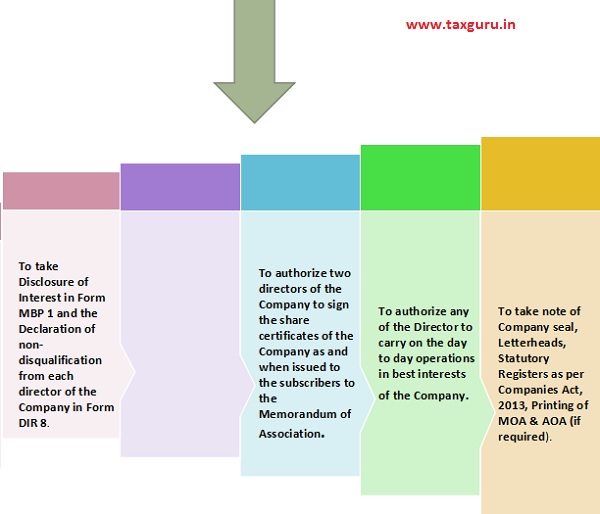
Explanation I:
Within 30 days from the date of incorporation of the Company, the company shall hold first Board Meeting of the Company and the following agendas are required to be discussed:
first Board Meeting of the Company
Within 30 days from the date of incorporation of the Company, the company shall hold first Board Meeting of the Company and the following agendas are required to be discussed:
Part II: Compliances under GST Act
GST registration
Company in India is required to register under GST Act i.e Goods & Service Act. The government will issue a GSTIN to be used for the future correspondences of the business of the company
Filing of returns
The Company is required to file the periodical (monthly & annually) returns as prescribed by the government on the prescribed due dates to provide detail regarding sale and purchase of goods & services and for claiming the input credit also.
Part III: Compliances under FEMA, RBI/FDI Reporting
 
Within 30 days from the date of allotment of subscription money, Form FC-GPR has to be filled on FIRMS, RBI Portal. And to report the FDI, the Company should register itself with the Entity User and Business user on FIRMS, RBI Portal.
Filling of Annual Return of Assets and Liabilities (“FLA Return”) by 15th day of July every year in respect of FDI on FLAIR portal of RBI and to file FLA Return, the Company should register itself on the FLAIR portal of RBI
Note: In case the subscribers to the memorandum of association of the Company are foreign nationals or the funds have been received by the Company from the country other than India, then the FDI Reporting under FEMA Regulations, 1999 has to be complied with.
Part IV: Compliances with DGFT (Director General of Foreign Trade)
Application to obtain Import Export Code (“IEC”)
Govt. Fees for application for registration is Rs. 500/-.
Application for modification in IEC
The Company is required to intimate about the changes in the details given initially at time of applying IEC to the department for modification in the IEC.